

































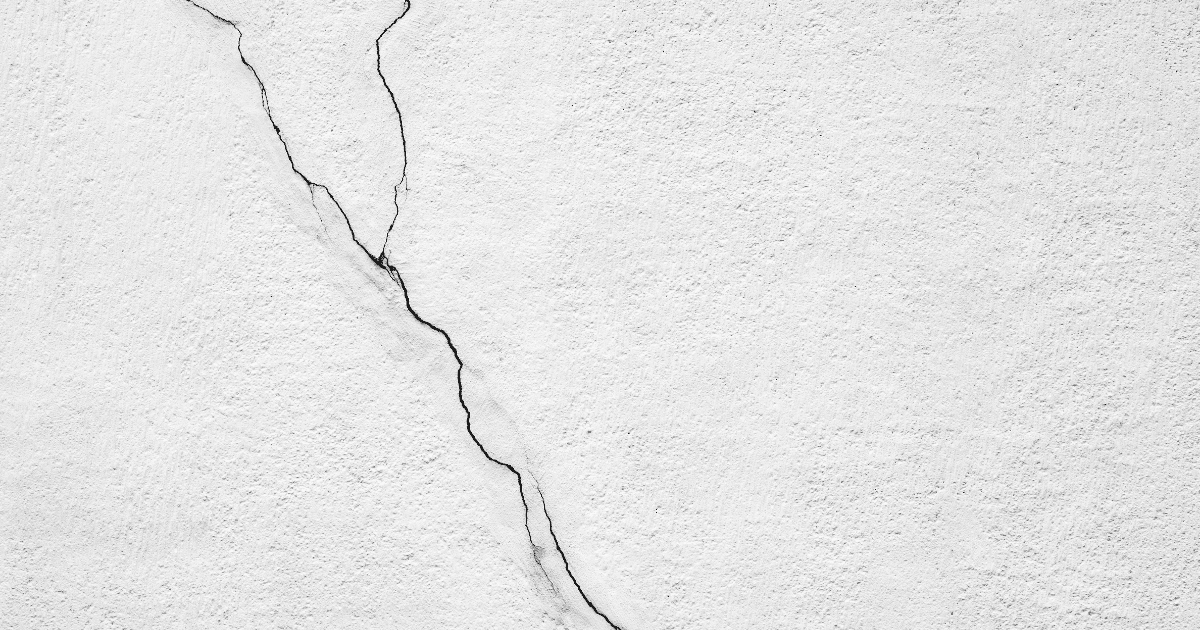
Cracks in walls are among the most common concerns for homeowners, landlords and property managers. In many cases, a small crack in wall finishes may be no more than normal shrinkage, thermal movement or ageing materials. But in other cases, this can be an early warning sign of settlement, loss of ground support or ongoing structural movement.
The challenge is knowing the difference.
At GEOSEC UK, we approach this issue by looking beyond the visible symptom. A fracture is rarely the problem in itself. More often, it is the surface expression of something happening below or around the structure. That is why the right response to structural damage is not simply to fill and repaint, but to understand the mechanism causing the movement in the first place. This diagnostic philosophy is consistent with GEOSEC’s wider technical approach: first identify the origin of the defect, then select the least invasive and most effective method of stabilisation.
What do wall cracks really mean?
Hairline cracking in plaster can often be superficial. By contrast, wider or progressive fractures, especially those that follow a stepped pattern through masonry or appear diagonally from openings, may point to differential settlement or structural stress. In practical terms, the most significant types of damage tend to be those that change over time, recur after repair, affect brickwork as well as finishes, or are associated with other symptoms such as sticking doors, sloping floors or gaps around frames.
This matters because buildings do not crack randomly. Visible cracking often reflects how loads are being redistributed through the structure. If part of the foundation loses support, or if the ground beneath a property becomes less uniform due to moisture variation, washout, voiding or compressibility differences, the building responds. The result may appear first as a single fracture in interior finishes, but the underlying cause can be far more significant. GEOSEC’s published technical material repeatedly shows that loss of support, voids, moisture-related anomalies and weakened soils can all contribute to settlement-related damage in slabs, foundations and masonry.
When does cracking become structural?
The term structural damage should be used carefully, but there are clear warning signs that justify specialist assessment. These include fractures that are diagonal, stepped through brick joints, wider at one end than the other, located near corners of doors and windows, or accompanied by distortion elsewhere in the building. External damage that mirrors internal damage is also significant. So is evidence that repairs have failed repeatedly.
In many cases, this type of damage is linked to foundation movement rather than defects in the wall alone. This is why traditional cosmetic repair often disappoints. If the support conditions remain unchanged, the fracture may reopen because the structure is still moving.
A sound engineering response starts with diagnosis. GEOSEC’s technical case studies describe how investigation can include ground characterisation, dynamic testing and, where appropriate, electrical resistivity tomography to identify moisture, voids and anomalous zones below the structure. This helps distinguish between superficial surface damage and movement associated with deeper ground-related causes.
Why wall cracking is often linked to the ground
Many people focus only on the visible damage, but buildings depend on the uniform performance of the ground beneath them. When that support changes, damage to walls may follow.
Ground-related causes can include softening of subsoil, local washout, void formation, water ingress, non-uniform fill, deterioration of bearing conditions, or long-term settlement. GEOSEC’s case histories show that these mechanisms are not theoretical. They have been identified in real projects affecting slabs, retaining structures, industrial floors and foundations, with investigation confirming anomalies such as moisture concentration, cavities and reduced support capacity.
For domestic and light commercial properties, the visible signs may start modestly: a fracture in wall plaster, a stair-step pattern in brickwork, or doors that suddenly no longer align. But if the cause is movement at foundation level, acting early is important. The sooner the mechanism is understood, the greater the chance of limiting damage and avoiding more disruptive repair.
A diagnostic-led solution, not just a cosmetic repair
At GEOSEC UK, the emphasis is on solving the cause, not masking the symptom. Where wall damage is linked to shallow loss of support or local ground instability, expanding resin injection can be used to densify and consolidate the soil with very limited disruption. GEOSEC’s published material describes this process as a low-invasive method designed to improve bearing capacity, fill voids and restore support conditions beneath slabs and foundations. In monitored interventions, improvements in soil response and bearing performance have been verified through testing and instrumental control.
Where deeper support or higher structural demands are involved, micropiles may be the more appropriate solution. GEOSEC’s GROUNDFIX® system has been presented as a rapid, low-headroom, low-vibration underpinning technique suitable for restricted-access and sensitive environments, with individual control of load achievement during installation. This makes it particularly relevant where damage is associated with foundation inadequacy, difficult access or the need for a cleaner alternative to traditional piling methods.
Why early action matters
One of the biggest mistakes with visible cracking is to assume that all damage can wait. Some can. Some cannot.
If movement is active, delay may lead to wider fractures, more secondary damage, higher repair costs and greater operational disruption. In commercial settings, it can also affect safety, appearance, tenant confidence and maintenance budgets. From an engineering and asset-management perspective, earlier diagnosis usually means better control over the scope of remedial works.
GEOSEC’s wider technical record shows a consistent principle: effective intervention depends on understanding the structure-ground interaction and applying the right technique at the right depth, under controlled conditions. Whether the solution is resin injection, micropiles, or a combined approach, the aim is always the same: stabilise the support conditions so that the building can perform as intended.
When to seek specialist advice
You should consider specialist assessment if:
- Wall damage is widening or recurring
- A stepped or diagonal pattern appears in brickwork
- Damage is appearing both internally and externally
- Doors or windows are sticking without another obvious cause
- There is visible separation around frames, skirtings or ceilings
- You suspect settlement or previous repairs have not lasted
Not every fracture means serious structural failure. But where movement of the structure is suspected, informed diagnosis is the right first step.
GEOSEC UK’s approach
GEOSEC UK supports property owners, engineers and asset managers with a methodology based on diagnosis, engineering judgement and minimally invasive ground improvement or underpinning techniques. That means assessing the likely cause of the visible damage, identifying whether the issue is superficial or structural, and then selecting the most suitable solution for the building and the ground conditions.
In practice, that may mean shallow consolidation using expanding resin, deeper stabilisation with micropiles, or additional site investigation where the mechanism is still uncertain. What matters is not simply closing the visible fracture, but restoring confidence in the structure behind it. GEOSEC’s technical publications show that this approach has already been applied across a wide range of structural and ground-related pathologies, with emphasis on speed, control and reduced disruption.